

Australia has been one of the most preferred destinations of the International students for education and work for decades. As per the latest KPMG report released in May 2025, care economy jobs in health and childcare making them the fastest growing occupations in the Australian market between 2014 to 2014. KPMG Australia analysis also reveals that Tech & IT Professionals, Marketers, HR Professionals, Chefs & Cooks and Truck & Delivery Drivers round out the list as the current economy and the prioritisation of wellbeing and health significantly alter Australia’s occupational structure. This report serves as a valuable guide for International students for selecting qualifications/courses that can align them with the current and future workforce requirements of the Australian job market.
Here’s a detailed description of the fastest growing jobs in Australia in 2025 and the relevant courses that the students can opt for:
● Aged & Disabled Care Workers (+98%)
Registered nurses, aged care workers, and other healthcare professionals are highly sought after due to the aging population. The careers in this sector are expected to rise exponentially in the coming years as the older population of the country, who have no one to take care of, are looking forward to care support and therefore the Government of Australia is prioritising this sector as one of the crucial areas for providing jobs.
Relevant courses: Certificate III in Individual Support (Ageing), Certificate IV in Ageing Support, and various nursing degrees and postgraduate qualifications. For aspiring nurses, Bachelor of Nursing or Diploma of Nursing (enrolled nurse) are common entry points, with further specialization available through advanced diplomas or master’s degrees
● IT and Tech: Tech & IT Professionals (+55%)
Software developers, data analysts, cyber security specialists, and other tech professionals are in high demand as businesses embrace technology.
In 2025, the Australian IT sector is projected to see strong growth, particularly in areas like cloud computing, cyber security, and AI. High-demand roles include software developers, data scientists, and cyber security specialists. Specific areas with high demand are:
● Cloud Computing
● Cyber security
● AI
● Software Development
● Data Science
Onshore and offshore models of hiring are being adopted by the job providers and experts at ACET will help you get connected to businesses that will best suit your qualifications. Click here to know more.
Relevant courses; Bachelor of Information Technology, Bachelor of Computer Science, and Bachelor of Cyber Security. Postgraduate options such as Master of Information Technology and Master of Data Science are also widely available
● Marketing, Advertising and PR (+40.9%)
Australia’s marketing, advertising, and public relations (PR) sector offers diverse job opportunities, ranging from entry-level roles to senior management positions. Specific roles include marketing executives, specialists, managers, and directors, as well as those focused on digital marketing, content creation, social media, and PR strategies
Relevant courses: Bachelor of Marketing, Diploma of Social Media Marketing
● Nurses and Midwives (+29%)
The demand for nursing jobs in Australia is higher than ever, with the healthcare sector continuously growing to meet the needs of an aging population and evolving medical advancements. Similarly Midwives are in demand and midwifery has excellent rates of employment.
These professionals can find opportunities in hospitals, community health centres, aged care facilities, and other healthcare settings, including remote locations
Relevant courses: Bachelor of Nursing, Bachelor of Nursing/Bachelor of Midwifery, Diploma of Nursing, and postgraduate options like Graduate Diplomas and Master’s degrees in various specializations
ACET is offering visa pathway for NCELX-RN – Click here to know more
● Allied Health Workers (+83.9%) –
Allied health professionals in Australia have diverse career opportunities, with high demand in various settings like hospitals, aged care facilities, disability services, and community health centres. They can work in specialized roles like physiotherapy, occupational therapy, speech therapy, and more, with many finding employment in private practices, rehabilitation clinics, and even the sports and fitness industry.
Relevant courses: Certificate III and IV to Bachelor’s and Master’s degrees. These courses cover various specializations, including allied health assistance, mental health, medical imaging, and specific therapies like physiotherapy and occupational therapy.
● Human Resources Professionals (+41.2%) –
The Australian human resources (HR) sector offers substantial job potential for professionals, with ongoing demand across various industries. The overall market is vibrant with opportunities, particularly for junior to mid-level roles like HR Advisors and HR Business Partners. The Australian Government projects a significant increase in HR manager positions by 2025, further highlighting the sector’s growth potential
Relevant courses: Bachelor of Business (HR), Diploma in Human Resources Management –
● Chefs, Cooks and Kitchen Hands (+26.1%) –
The hospitality sector provides opportunities for chefs to work globally, with Australia being a stepping stone for international careers. Chefs and cooks in Australia have high job potential, with the sector experiencing strong demand and career growth opportunities. This is due to factors like the expanding hospitality industry, a surge in tourism, and an increased need for skilled culinary professionals. The Australian government has also acknowledged the importance of this profession, including chefs on its Skills Priority List and investing in vocational education and training
Relevant courses: Certificate III and IV in Commercial Cookery, Diploma of Hospitality Management.
● Early Childhood & Child Care (+52.5%) and teachers (+23.6%)
In Australia, there’s a high demand for teachers, lecturers, and childcare workers, especially in rural and remote areas. This is due to population growth, government initiatives supporting early childhood education, and a lack of local training opportunities in rural areas which is resulting in fewer qualified professionals, making it difficult to fill positions. Many regional towns are expanding, leading to increased demand for childcare and educational services. Older teachers are retiring, creating a need for new teachers. Another important reason is that the parents and carers returning to work or study and thus increasing the need for childcare and early childhood programs. There’s a significant shortage of early childhood educators in many areas, particularly in rural and remote regions. There’s a strong demand for teachers with expertise in specific areas like special and inclusive education, math, science, and technology.
Relevant courses: Bachelor of Education (Early Childhood, Primary, Secondary) , The Graduate Diploma in Early Childhood Education is designed for individuals who already hold a bachelor’s degree in a discipline other than early childhood. This one-year program provides a pathway to become a qualified early childhood teacher, preparing you to teach children from birth to five years old.
● Engineering (+14.9%)
Australia is investing heavily in infrastructure, requiring a skilled workforce to build and maintain roads, railways, and other public works. Civil, electrical, mechanical, and mining engineers are needed for infrastructure and energy projects as currently Australia is facing an engineering skills shortage. These fields are vital for the country’s growth. The shift towards sustainable energy sources like solar and wind power, strong mining industry base creates significant demand for electrical, mechanical and mining engineers.
Australia has also recently introduced the Core Skills Occupation List (CSOL) which identifies occupations critical to Australia’s economy, with engineering professions among the most in-demand. This will help Australia align with its labour market needs and address the skill shortages.
Relevant courses: Bachelor of Engineering (Civil, Mechanical, Electrical), along with specialized fields like Construction Management, Building and Construction Diplomas, and relevant trade certifications.
● Construction and Trades:
Plumbers, electricians, carpenters, and construction managers are needed for booming construction and housing markets. According to data shared by The Australian Bureau of Statistics, construction is the third largest industry in Australia – both by its share in the total national GDP and also by the number of people it has been employing. With a steady growth, employment has been increasing in this industry. Occupations that are in demand:
● Electricians
● Construction Managers
● Plumbers
● Architectural, Building and Surveying Technicians
● Building and Plumbing Labourers
● Civil Engineering Professionals
● Carpenters and Joiners
● Insulation and Home Improvement Installers
● Structural Steel and Welding Trades Workers
● Air-conditioning and Refrigeration Mechanics
● Concreters
Relevant courses : In the Australian Construction and Trades sector, a range of courses are available, from entry-level certificates to higher-level diplomas and degrees. Popular choices include Carpentry, Bricklaying, Plastering, and Electro technology. There’s also a strong focus on specialized trades like Engineering Fabrication, Automotive Technology, and Commercial Cookery.
An important excerpt from the KPMG report that talks about the changing occupational structure which have been discussed above.
In total the number of workers in Australia has increased by 22.9% between 2014 and 2024 from 11.4 million to 14.0 million, with the ten top-growing occupational groupings accounting for over 1 million new workers, representing almost 40% of all growth.
Care economy occupations like Aged & Disabled Care Workers (+98.0%) and Allied Health Workers (+83.9%) have almost doubled over the past decade. Early Childhood & Child Care (+52.5%) and Nurses & Midwives (+29.0%) have also seen strong growth.
“The surge in care economy occupations reflects a jobs market responding to Australia’s changing demographics,” said KPMG Urban Economist, Terry Rawnsley.
“As the older Baby Boomers enter their late 70’s and early 80’s the need to rapidly expand aged care and related health services grows stronger. Meanwhile, increased participation of women in the workforce has meant the demand for childcare has similarly increased over the last decade.”
“We are already seeing governments invest heavily in the aged care, disability support, and childcare sectors to meet future expected demand.”
Since 2014, the number of Tech & IT Professionals, including Software Programmers, Systems Administrators, and IT Security Specialists, has increased by 176,400, representing a 55.0% growth in the profession.
“These Tech & IT Professionals design, code, test, and maintain software applications, driving the digital infrastructure behind our essential online banking, shopping, and time-saving apps,” Rawnsley said.
“Many of these professionals also support IT systems across a range of non-tech businesses within the economy, so it isn’t all just about the glamorous end of tech development,” Rawnsley added.
This report underscores the requirements for future-focused education forecasts. Australia’s migration policies are increasingly linked to skills shortages and employment outcomes therefore it is important that students align their study plan with careers in demand while doing the groundwork of their future in Australia.
Growing occupational groupings 2014-2024
Growing occupational groupings 2014-2024
|
Occupation |
No. workers in 2014 |
No. workers in 2024 |
Additional workers |
Growth rate |
|
Aged & Disabled Care Workers |
216,900 |
429,400 |
212,500 |
98.0% |
|
Tech & IT Professionals |
320,900 |
497,300 |
176,400 |
55.0% |
|
Early Childhood & Child Care |
168,500 |
257,000 |
88,500 |
52.5% |
|
Marketing, Ad & PR Professionals |
211,100 |
297,500 |
86,400 |
40.9% |
|
Nurses & Midwives |
297,200 |
383,500 |
86,300 |
29.0% |
|
Allied Health Workers |
102,900 |
189,200 |
86,300 |
83.9% |
|
Human Resources Professionals |
187,400 |
264,700 |
77,300 |
41.2% |
|
Chefs, Cooks & Kitchen Hands |
288,600 |
363,900 |
75,300 |
26.1% |
|
Teachers |
311,400 |
384,800 |
73,400 |
23.6% |
|
Truck & Delivery Drivers |
270,400 |
337,700 |
67,300 |
24.9% |
Source: KPMG calculated estimates for the size of each occupation by combining data from The Australian Tax Office tax returns, Employment data from the Census, The Australian Bureau of Statistics Labour Force Surveys and Jobs & Skills Australia NERO data sets.
Note: The top growing occupation groups were ordered by the number of additional workers.
Skilled migration and job opportunities in Australia – How to achieve it ?
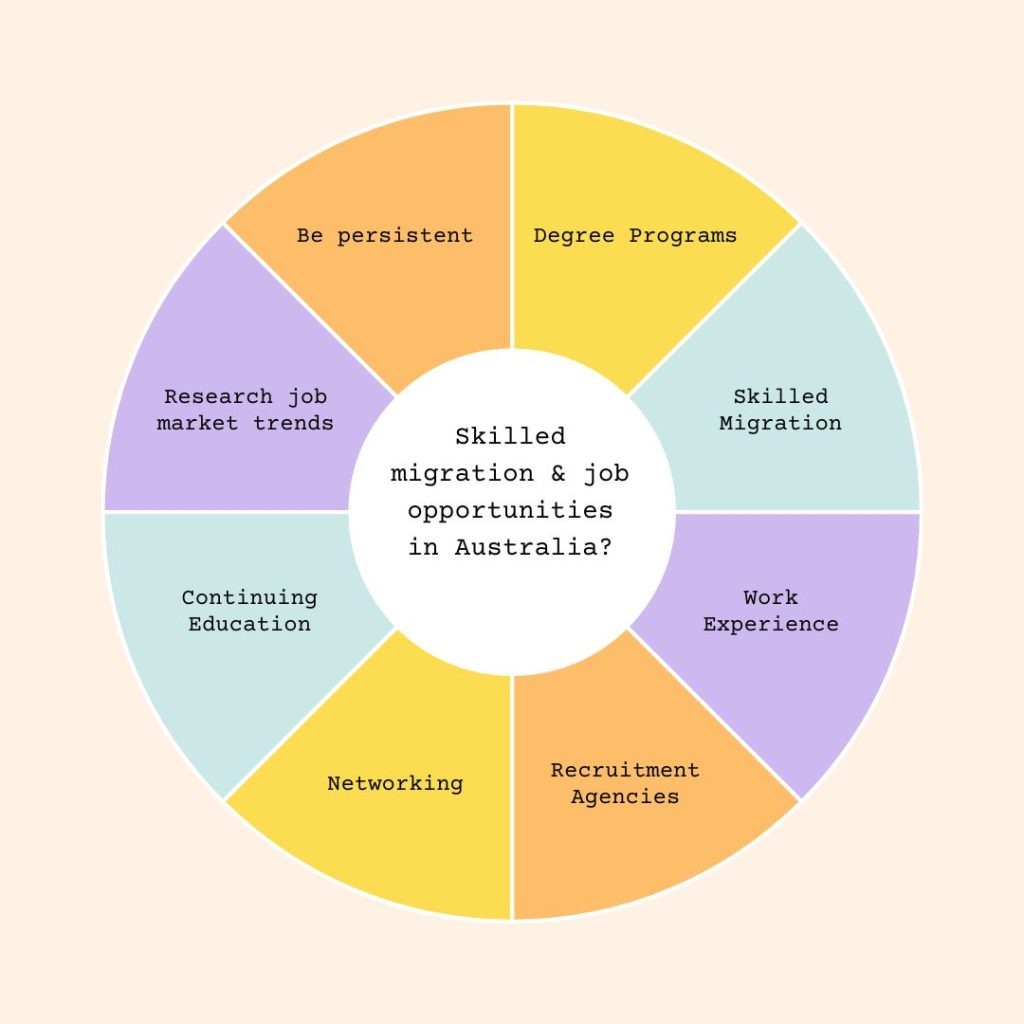
Lorem ipsum dolor sit amet, consectetur adipiscing elit. Ut elit tellus, luctus nec ullamcorper mattis, pulvinar dapibus leo.
●
Degree Programs:
Pursuing a degree in a field like
engineering, nursing, IT or the above mentioned sectors in demand can open
doors to skilled migration and job opportunities.
●
Skilled Migration:
The Australian Skilled Migration
program allows individuals with skills and experience to apply for a work
visa. Click here to
contact ACET to know more
●
Work Experience:
Gaining experience through
part-time jobs while studying and internships can boost your career
prospects.
●
Recruitment Agencies:
Contacting recruitment agencies can
help you find job opportunities and get your details in their database. Click here to contact ACET to
know more
●
Networking:
Building a professional network can
also increase your chances of finding employment.
●
Continuing Education:
Consider pursuing further education
or training to enhance your skills and knowledge. Take courses, attend
workshops, and gain practical experience to enhance your skills.
●
Research job market trends:
Stay informed about the latest
trends and demands in the Australian job market.
●
Be persistent:
Finding a job as an international
student may take time, but don’t give up.
Australia has
always been a dream for the international students to fulfil their academic
aspirations and to also build a bright career. Its significant academic
standards, future forward economy and the clear connectivity to career paths
have given an upper edge to Australia.
Perks of employment in Australia
●
Superannuation: Employers are legally
obligated to contribute a minimum of 11% of an employee’s ordinary time
earnings to their superannuation fund.
●
Great leave system:
●
Full-time employees receive 4 weeks of paid annual
leave.
●
Employees are entitled to paid sick leave, and in
some cases, carer’s leave.
●
Parental Leave: Both parents are eligible for
paid parental leave.
●
Long Service Leave: Entitlements vary based on
length of service and state/territory regulations.
●
Workers’ Compensation: Employers are required to
provide workers’ compensation insurance to cover workplace injuries.
●
Minimum Wage: The Fair Work Act 2009 and
National Employment Standards (NES) set minimum wage standards.
●
Public Holidays: Employees are entitled to
paid time off for public holidays.
Supplementary Benefits:
●
Flexible Working: Many employers offer flexible
working arrangements, including remote work or flexible hours, to accommodate
employee needs.
●
Health Insurance: While Australia has a public
health system (Medicare), many employers offer additional health insurance
options to cover extras like dental and optical care.
●
Work-Life Balance Enhancements: Beyond standard
leave, some employers offer additional paid time off, wellness programs, or
extended holidays.
●
Employee Assistance Program (EAP): EAPs provide confidential
counselling and support for employees facing personal or professional
challenges.
●
Career Development: Some employers provide
opportunities for employees to advance their careers through training and
development programs.
If you are planning to study in Australia, it’s the best time for you. You should not only research
about the right courses that suit your skills and future plans but also get in
touch with the most credible migration agency who can guide you with the best
pathway.
ACET Migration Services is the right migration partner for your Australian PR and Visa. With offices in Darwin (3), Melbourne, Brisbane and Perth ACET is the largest MARA registered firm in NT, with a team of 8 registered migration agents.